
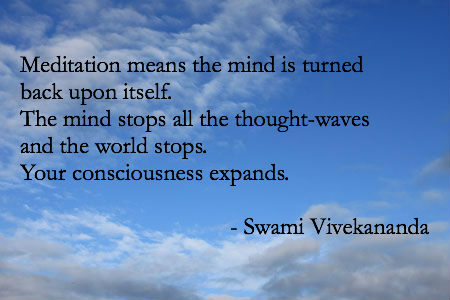
“Meditation means the mind is turned back upon itself. The mind stops all the thought-waves and the world stops. Your consciousness expands.”
– Swami Vivekananda
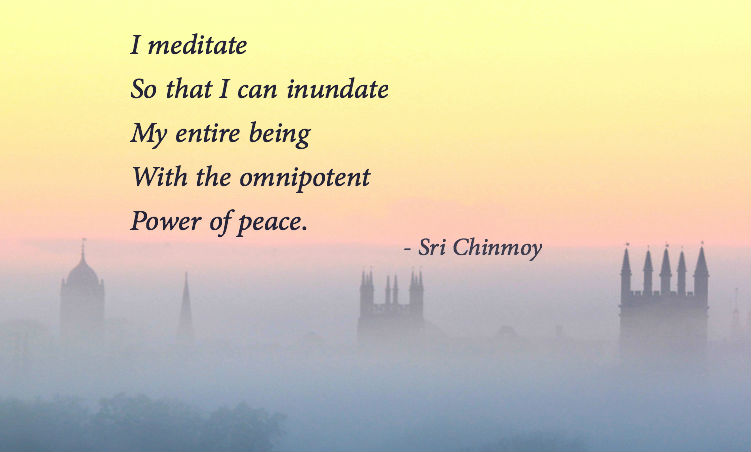
I meditate
So that I can inundate
My entire being
With the omnipotent
Power of peace.

The main thing in starting to meditate is to just do it. Meditation is absolutely natural and normal, and once we begin it is simple to make it an integral part of our lives. Because meditation concerns our own heart and soul, it turns out to be very intimate and familiar to us. Like a close and faithful friend, our meditation will be something that we know very well and is always there for us.
Meditation becomes natural and spontaneous when we do it regularly. We can make a comparison to the food which we need to eat each day. Meditation is spiritual nourishment, and just as we eat daily we should meditate at least once a day. We don’t try to eat all of our food for the whole week in one meal. In the same way we meditate regularly so we can receive the spiritual food we need.
Other comparisons we can make are to training for physical fitness or learning to play a musical instrument. Our ability to meditate grows with practice, like developing a muscle or learning a skill. Doing some each day is really effective, while skipping several days and then practicing a lot doesn’t work well. When beginning to meditate and also as we continue, we should meditate for the same amount of time each day, according to our capacity, and increase the length of our meditations only gradually.
Having a definite time to meditate is important. Then we don’t think about when or whether to meditate, we just do it. Our outer self as well as our inner being starts to feel that meditation is a totally normal and necessary part of our life. Meditation early each morning is a foundation for our practice. At that time all of the stresses and distractions of the day have not entered into us and we are fresh. We can receive strength and light from our meditation and then draw on it during the day. If we can meditate again in the evening, this is ideal. If we have a chance, we might fit in short meditations at other times.
Having a special place for meditation is a great help. People who can have a meditation room are lucky, but just a corner or small space is all we need. This spot is set aside just for meditation and perhaps spiritual reading and music as well. We can keep sacred pictures in that place and any other things that inspire us, put flowers there and burn incense. This place will build up a spiritual atmosphere and associations with our inner life, so that when we sit down there we will automatically feel like meditating.
Meditating right after a full meal is difficult. So is meditating when we are very hungry, so a light snack before starting to meditate can be useful at certain times. Taking a shower and wearing clean clothes are good preparations. But even if none of the supporting conditions mentioned here are available, we should still meditate – any way we can, at any time we can.
Meditation will be easier some days than others, extremely fulfilling at one time and more ‘ordinary’ at some other time. These variations are all part of the process. We must keep going forward with joy and confidence. Wonderful discoveries lie ahead!
-Kusumita P. Pedersen
Kusumita is a meditation student of Sri Chinmoy and lives in New York where she is a member of the New York Sri Chinmoy Centre. For more information about Meditation in New York visit – Meditation New York

This is a guest post by Teekshanam Dodonu. Teekshanam lives in Geneva where he helps to organise Meditation classes. See: Geneva meditation for more details
Meditation is cool. It really is.
Seven years ago when I first started to meditate, it felt like something beyond reach for us, the mere mortals, that only seriously minded individuals would practice. It also seemed complicated in the sense that you are not supposed to do anything and at the same time something was supposed to be happening. And then there were all the do’s and dont’s — sit straight, keep your mind under control, eat this or do not eat that – as well as the endless approaches to meditation.
As I look back, I am surprised at how simple meditation can actually be. It also amazes me how such a simple thing as meditation can change one’s life – only for the better.
I wake up in the morning. I meditate. I do my workout and then prepare for the day. I come back home. I try to find a few minutes to meditate in the evening and then do something else. My day has a start I can effortlessly control – my morning meditation. My day has a natural transition and ending point – my evening meditation. I am confidently in control again.
Before it used to be sleeping and doing daily duties. Now there is more. There is a time in the morning when I am with myself, consciously with myself. It’s neither sleeping nor working. It’s just being with myself. In the evening, the experiences collected during the day are put to rest. All extraneous mental and emotional weight is acknowledged and let go of. I am with myself again.
And then there is the miracle of seeing results without caring too much about them. Here’s a useful analogy. Try to bring before your mind’s inner eye the image of a bird’s nest. What is it made of? Essentially, it consists of small pieces of wood, straw, dried offshoots and some sticky material like soil or clay. So what? Well, consider the constraints a small bird like a sparrow has to face: a small beak, no arms, not much strength. Yet, despite her smallness, it manages to build a nest for herself and her family to last a lifetime.
What’s the secret? Perseverance and focused repetitive behaviour consisting of hundreds and thousands of trips to locate, collect and bring the needed building material to the construction site of the nest. Tedious and boring? Maybe. Successful, useful and practical? You bet!
Meditation can be likened to a sparrow’s effort to build a nest. Meditating once a month would not amount to much, although it is better than not doing it at all. At this rate of progress, it would take many generations of sparrows to complete the nest. If they can survive many winters without a nest, that is.
Meditating every day, on the other hand, can make a world of difference in a relatively short span of time. You may or may not notice it yourself simply because of the habit of being with yourself at all times. Not so for others, who will notice the change or will see something special in you that they normally do not see in others. Being complimented on your ability to maintain your calm amidst challenging situations or spontaneously exhibiting unconditional goodwill to people who do not expect it are just insignificant by-products of a major transformative cycle of personal growth you embark upon.
I just cannot stop being amazed at how cool meditation is.
- An Introduction to Meditation
- Basic Steps for Learning Meditation
- Improving Your Meditation
- How To Gain Control of Your Thoughts
- Benefits of Meditation
- 7 Tips for Meditation
- Is Meditation Difficult?
- The Mind and the Heart in Meditation
- Common Questions about Meditation
Meditation Techniques
Personal Experiences of Meditation
Learning to Meditate
- Learning to Meditate in London
- Bristol Meditation
- New York Meditation
- Dublin Meditation
If you are interested in learning about meditation. There are a few meditation exercises on this site which will help you get started.
It is helpful if you can find a group to learn meditation with other people. When we meditate in a group we gain inspiration from others. A group meditation creates a powerful sense of silence and focus. In many cities, Sri Chinmoy Centres offer free meditation classes. You may find a city near you. Meditation at Sri Chinmoy Centre.
For the latest articles on Meditation, you might like to view Meditation Category at our Self Improvement blog.
Recent articles include:
Things I Have Learnt from Meditation

Many beginners to meditation ask what is a good length of time to meditate for. The answer depends on the seeker and the inspiration they feel. Generally, it is not easy to give a particular time period; but, in the beginning, it is good to aim for at least 15 minutes.
If you meditate for too long, the mind will start to rebel; it will become very difficult to control your thoughts and you may feel a pressure in the third eye, a little bit like a headache. For beginners it is important not to pull beyond their capacity. When we try to pull in too much spiritual light, we cannot hold it. Similarly, if we meditate for too long, we will just feel a barren desert and derive no benefit at all. At this time, we would be better served by reading spiritual books or chanting mantras.
When we have been meditating for a few times, we will soon be able to tell when we are really meditating, and when we are just sitting there for the sake of it. If we just sit for a long time we may go through different cycles of thoughts and not get anywhere. When this occurs, it is a good time to stop.
We should always remember that we meditate for our own benefit. What matters is our sincerity. Nobody is watching over us giving us a reward if we meditate for a long time. We should always feel we are meditating to feed the inner pilot and strengthen our inner capacities. If we start to feel proud and pleased with ourselves for meditating a long time, we should no this is not a good sign. Real meditation will never give us a feeling of superiority; instead we will gain a feeling of oneness. If we sit in meditation for a long time and feel bloated with spiritual pride, this is a sign that we are meditating too long. As Sri Chinmoy suggests
“It is not how many hours you meditate but how you meditate. If you can meditate soulfully and devotedly for fifteen minutes and sincerely cry for Peace, Light and Bliss, that is better than three hours of meditation without any life in it. When you meditate, if there is a living presence in it, then that is meditation. Otherwise it is no better than sleep or death.” [1]
Another factor to bear in mind, is that when we sit down to meditate, in the beginning our mind will be all over the place. This is because it takes time for the mind to calm down. Therefore, if we meditate after coming home from work, the first 10 minutes may be very unproductive. However, after the initial period of 10 minutes, we may find that we start to really meditate. Thus, we may need to set aside 20-30 minutes, in order to meditate well for 10 minutes.
When we become more advanced in meditation, we should try to advance the time spent in meditation. If we feel an inner urge to deepen our meditation and find the real silence within, then we should definitely follow this. To attain higher states of meditation it is necessary to develop the capacity to meditate for a long time of 1-2 hours. Adepts in meditation can meditate for several hours at a time. However, in the highest state of meditation, we lose track of time; this is because the highest meditation transcends concepts of time. If we are able to enter into the highest state of meditation, we will become completely unaware of time, it will no longer be an issue.
However, we have to start from where we are. To meditate soulfully for an hour maybe our goal; but, in the beginning we need to focus on the quality of our meditation, rather than the length of time.
[1] Excerpt from Meditation: Humanity’s Race And Divinity’s Grace, Part 1 by Sri Chinmoy.
By: Tejvan Pettinger. Tejvan is a member of the Oxford Sri Chinmoy Centre and gives free meditation classes in his home town. Tejvan has studied meditation under the guidance of Sri Chinmoy for 8 years.
Photo from: World Harmony Run site
Statues and pictures are an important part of many spiritual traditions, whereas other traditions view them as obscuring the real nature of the truth. The latter hold that since God is formless and beyond human comprehension, people should meditate on the formless Reality rather than pictures or statues. It is certainly true that God is beyond the comprehension of the limited human mind. And it is also true that in the past, people have engaged in idol worship of statues rather than focusing on their inner life. However, for thousands of years statues and pictures have served as an inspiration for many spiritual seekers to reach the highest. When we look at a stature or a picture of a great spiritual master, we feel tremendous peace and love emanating from his features, which inspires us to pursue our prayers and meditations to find the Source of that peace and love.
One of the main obstacles on the spiritual path is doubt: at times the limiting mind clouds our view and we doubt that God really exists, but more often we doubt ourselves, we doubt that it is possible for us or indeed any human being to overcome the defects of our nature and reach the Highest. However, if we know of people who have reached that goal, we become surcharged with new inspiration, and we are filled again with determination to climb the mountain that these saints have successfully scaled. Even people who have no connection with spirituality whatsoever nowadays often have a Buddha statue in their houses: the statue creates a sense of peace and serenity, and indeed perhaps it may in future inspire them if they decide want to explore the inner life more fully.
In recent years, photographs of great spiritual teachers have become an invaluable resource for their students, especially when they are physically separated from the master. When they meditate on the photograph, they are not meditating on the physical person of the master, they are meditating on the meditative consciousness which through years of meditation has risen above all earthly fetters to become one with the highest. Through this meditation, they get a glimpse into this vast state of oneness with God, which inspires them to press ahead in their own spiritual journey until they can reach that state for themselves.
Comments
2007-08-28 02:40 | Posted by Olga | https://www.sunnyray.org/indexE.htm I am awed by the maturity and insight that the author shows while contemplating on the subject of approaching God. Even more simple is turning our attention toward our inner being, and, in this way, expanding our consciousness. This will bring us to the Source of all things. The statues and pictures can sometimes pull our attention off, but they can certainly be beneficial in the beginnings of one’s meditativeness.
Meditation is an inner activity. When we meditate we make an inner connection with our inner pilot, our inner self. To attain the highest meditative consciousness we do not need any outer aids. However, if we are a beginner then there are several things that can help us in our meditation. Although they may only add a little benefit to our meditation, it is definitely worth taking the help of these outer aids.
1. Flowers
Having flowers on our shrine help our meditation. The fragrance and beauty of a flower help to create an inspiring atmosphere. When we look at a beautiful flower, we momentarily gain happiness and this helps us to enter into a good meditation.
2. Candle.
A candle is a symbol of our inner flame of aspiration. When we see a candle flame, we are reminded of this inner aspiration. A candle flame embodies great simplicity; it is simply a flame of one pointed aspiration up to the highest. The second aspect of a candle is light; the outer light is again symbolic of the inner light we seek to discover in our meditation. Thus, a candle is a very useful addition to our meditation shrine.
“You can concentrate anywhere: on the heart, on a candle or on any object. But if you are concentrating on a candle flame, please feel that nothing exists between you and the flame. Feel that nothing exists in your aspiring world but the flame; and while concentrating, feel that the inner flame is climbing high, higher, highest. The candle flame means aspiration. When you look at the flame, try to feel that you are aspiring, that there is no thought, nothing, in you or around you.”
– Sri Chinmoy [1]
3. Incense.
Good quality incense helps to purify the air and create a spiritual vibration. Burning incense helps to create a meditative vibration, and over time we will associate the smell of incense with meditation. Thus, when we burn incense we will feel ready for meditation.
4. Meditation Cushion.
If we can learn to sit on the floor in the correct way, we will find our meditation improves. If we can sit on the floor with our back straight, meditation can become more fruitful than sitting in a chair. Sitting on the floor, we are less likely to fall asleep and will have a posture more conducive to meditation. However, when we sit on the floor we need to make sure that we are balanced. If we just sit cross legged, we will have a tendency to lean forward. To compensate for this we will strain our muscles, making it difficult to forget the body. However, if we use a meditation cushion or meditation stool we raise ourselves off the floor and enable our knees to be parallel to our thighs. In this position we will be comfortable and can sit in perfect balance for a long time.
5. Clean light Clothes.
A significant aspect of meditation is purity. When we meditate powerfully we will feel tremendous purity in our inner system. This purity will give tremendous joy. To gain inner purity we should give importance to outer cleanliness. If we have a shower and wear clean and light clothes it will expedite our meditation.
It possible to meditate well without using any of these objects, but, if you do use some of these outer aids you will help create an inspiring place and vibration to meditate. Also by preparing a meditation shrine we give our meditation greater importance and focus.
[1] Excerpt from The Silent Mind by Sri Chinmoy.